Novel Sustainable Bridge Design
KliNa Project of the Month 01/2026.
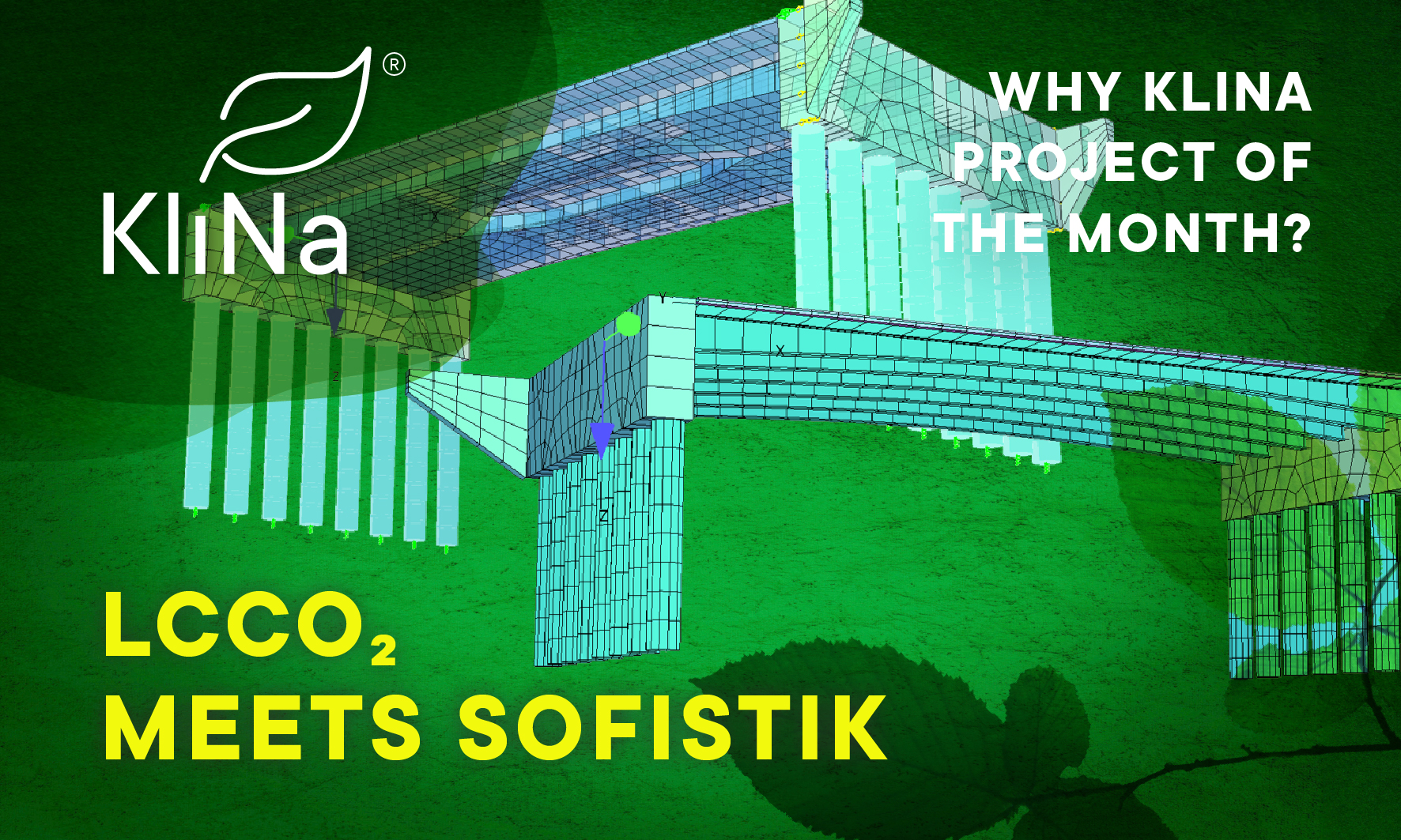
Vienna, 15 January 2026. The SOFiSTiK-LCCO₂-interface developed by FCP enables automated ecological, economic and strategic comparison of bridge models already in the design phase over their whole life cycle and thus sustainable decisions where they are most effective.
How can ecological impacts of structures be made measurable and comparable already in the design phase? Inspired by this question colleagues from the Competence Center Bridge Design & Structural Analysis of FCP have developed an innovative solution which applies sustainable decisions where they are most effective: at the very beginning of the design process.
A program interface in SOFiSTiK automatically reads out quantities from parameterized structural models in future. These data form the basis for calculations in the internally developed LCCO₂-tool (Life Cycle Cost & CO₂), with which different models can be efficiently compared over the whole life cycle - ecologically, economically and strategically.
Sustainability as strategic core parameter
The team of developers consisting of Iztok Arnuga, Dominik Suza and Rebecca Lampe, summarizes the central innovation in one sentence: “We consider ecological impacts already in the design phase of the project as strategic core parameters.”
Thanks to a Python interface and parameterized SOFiSTiK models the relevant input parameters are automatically available for assessments in the LCCO₂-tool. Thus, sustainability is not assessed subsequently but is actively integrated in the planning process. This is a clear advantage compared to conventional approaches where a BIM model is often only available when essential decisions have already been taken.
Model comparison at the example of Steyr Bridge
A practical example of application is the analysis of various options at Steyr Bridge in Upper Austria (B138 Pyhrnpass Road, km 51.817), a road bridge over the Steyr river. Various structural solutions – reinforced concrete, prestressed concrete, composite prefabricated components – and their impacts over the whole life cycle were analysed. Already in a very early design phase alternative concepts could be assessed with regard to their CO₂e-emissions and the results were additionally verified via key figures like kg CO₂e per cubic metre.
More than ecology: holistic design approach
The great added value of this development is the holistic approach: Apart from ecological aspects also economic and strategic parameters are considered – considerably earlier than customary. At the same time designers develop an understanding which adjusting screws make a structure ecologically more efficient and how the latter can be used purposefully.
Great interest of public clients
The interface has already been successfully tested in a project and presented to public clients. There is great interest, the potential for future applications is respectively high – in particular against the background of increasing demands concerning climate protection, sustainability and transparent decision processes in infrastructure.
CC. CC Bridge Design & Structural Analysis
Location. Upper Austria, B138 Pyhrnpass Road km 51.817; road bridge over the Steyr river